


"Educational games we have developed bear fruit". Tatyana Ryupina talks about preschoolers' classes
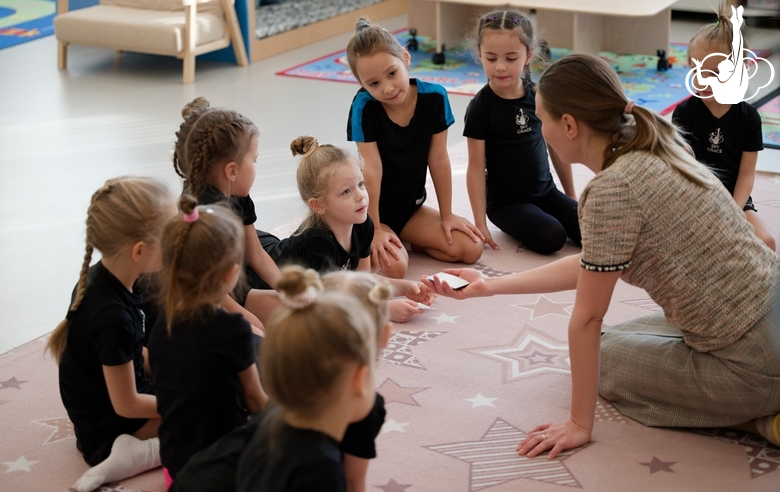
Tatyana Ryupina, the senior methodologist at the Talent and Success educational foundation, spoke about the new phase of classes for preschoolers in the free early development groups — the math games.
The specialist told how they go and what the children learn:
"Rhythmic gymnastics is an early-age sport. Its most active phase takes place during school. Therefore, to ensure our girls are successful not only in gymnastics but also in general education subjects, we actively utilize this preschool period of their development. We work on developing the ability to see the quantity of objects without counting. Firstly, children begin to understand the composition of numbers well; they won't have to memorize them later in school, and the pre-digital period is crucial for developing mathematical precursors. Furthermore, children begin to perform simple math operations in their heads: addition and subtraction. We've developed a series of educational games to help children visualize quantities. We use game equipment and cards with pictures of various toys. Children enjoy this and find it enjoyable."
The specialist explained the principle of the game:
"For young children, we don't just use cards. We use a soft block, which allows you to change the pictures. Using standard block as dice helps children memorize the locations of the dots. We change the locations of these dots on the blocks faces precisely so that children learn to quickly and easily recognize them. For older children, the rules of the game change. We’ve based it on “hot potato" meaning that the child must not only catch the block, but also quickly name the number of objects."
She also noted why such classes are important:
"The older they get, the more objects they learn to see. As they get older, they learn to structure the number of objects they see, and thus, they begin to perform their first arithmetic operations, such as addition, automatically. The educational games we've developed are producing results. The next step we're planning is comparison: more, less; how much more, how much less; and what the sum of the two cards will be."