


Coach Lyubov Cherkashina from Belarus talk about how the gymnasts of the team were preparing for the SCO Open Cup
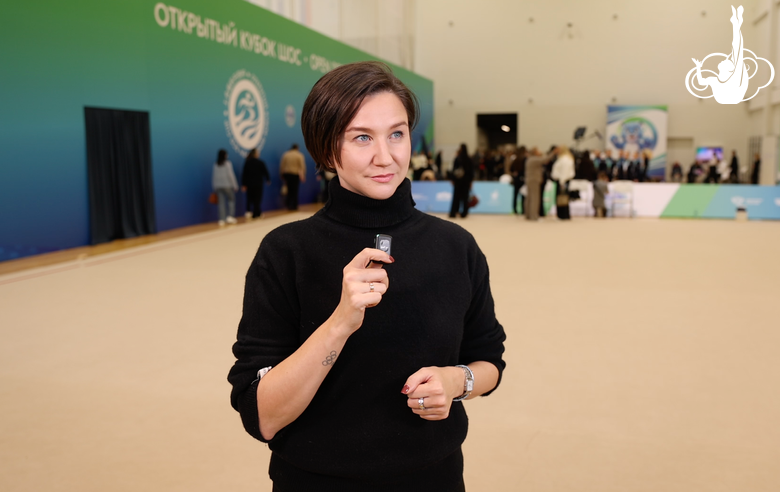
Coach Lyubov Cherkashina from Belarus told how the gymnasts of the team were preparing for the SCO Open Cup:
"They prepared well and very responsibly, understanding that these rules are a bit different, that in some places we needed to increase the difficulty of the routine, add a combined element somewhere, think through certain connections, and figure out where we would have a decoration and where we wouldn't. So we took all those nuances into account and had a bit of a brainstorming session for us together with the coaching staff. But in the end, I think it turned out well. Take Alina Kabaeva’s droplet, for example. Very few gymnasts in the world can actually do it. You need specific physical traits for that. But we put it into Margarita Zhurovich’s routine. I even noticed today that Kabaeva’s droplet is her phone wallpaper. Awesome! Way to go!"
She explained how the rules of the Association help unlock the potential of gymnasts and bring back unique elements to rhythmic gymnastics:
"There are nuances in how rotations are counted. Accordingly, this should theoretically motivate the gymnast even more. The more you rotate, the more you get, with a really good bonus. The exact same thing applies to rotational movements in risks. That means the more rolls you do, the more points you actually earn. Instead of just getting a 0.2 bonus for a series. So these nuances, these are great motivators, and the gymnast understands what she is working hard for and how her score will grow. That is why I really like these aspects, because they truly show the difference between a complex routine and an average routine. They really highlight that line. And, of course, the uniqueness lies in the fact that these rules are a big advantage for talented children, because you can do these high-amplitude movements, the splits, you can get a bonus for them."