


Judge Daria Sidorova explains which elements helped the tournament leaders get the highest score at the the second stage of the Cup of the Strongest
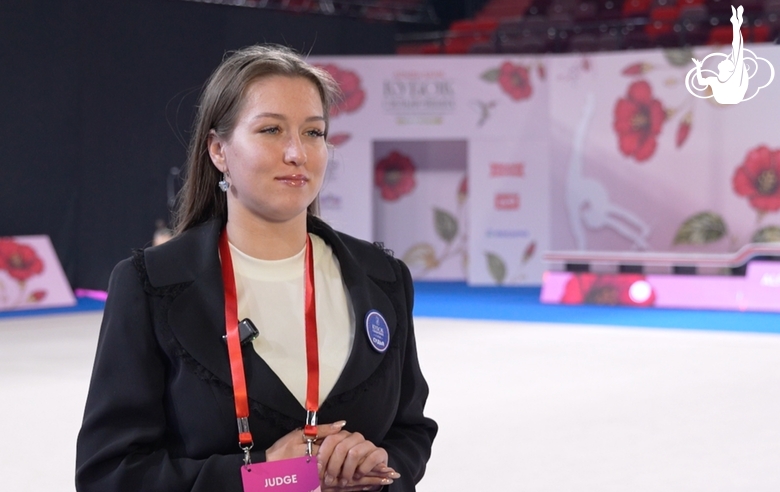
At the second stage of the Cup of the Strongest, judge Daria Sidorova from Tomsk explained which elements helped the tournament leaders get the highest score:
"Right now, in the current Olympic cycle, artistry and the artistic component of the composition are valued very high. There must be two dance steps, and there must be character in the routine. That is, the gymnast must tell some kind of story on the floor throughout the entire composition. Purity is a must. Losses are now evaluated very strictly for us. That is, a loss next to oneself is a deduction of 0.5, a loss with one step is 0.7, and if more than two steps, then it is already a full point. I also want to note the incredible risks. Both Mariia Borisova and Eva Kononova also demonstrated this to us. These are throws in a turn, without hands, without visual control, with three, and sometimes even four rotations under the throw. They also provide additional tenths, additional points, and thus a high score is being built up. The fouetté pivot is indeed very difficult. This is an element that has come to us from ballet. Each turn costs a certain number of tenths. It is clear that the more the gymnast twists, the higher the score she will receive accordingly."
She also analyzed the fouetté turn by Tyumen Region’s Eva Kononova's program and explained why it earned such a high score:
"No later than the second double turn, she performs the apparatus work, putting the hoop on herself. That is, the apparatus work is considered completed, the hoop has passed over two major parts of the body, in this case, the head and torso. The working leg opens clearly to 90 degrees, and during each rotation, the leg is pressed in passe, the working leg is pressed in passe. The gymnast maintains her point, which undoubtedly helps her to perform the rotations more accurately and easily. Also, the supporting leg does not lift off the floor, and the gymnast does not move from her position."