


In 1910, the premiere of the ballet The Firebird in Paris, presented by Sergei Diaghilev’s company, caused a sensation.
More than a century later, in India, we will present our own new production. It will blend various art forms with sport, and we are confident that it will leave a vivid, lasting impression on every member of the audience.
In the meantime, we’ll share more details about the original production, the participants, and how the concept has been reimagined over time.
Only 2 weeks left until the festival.
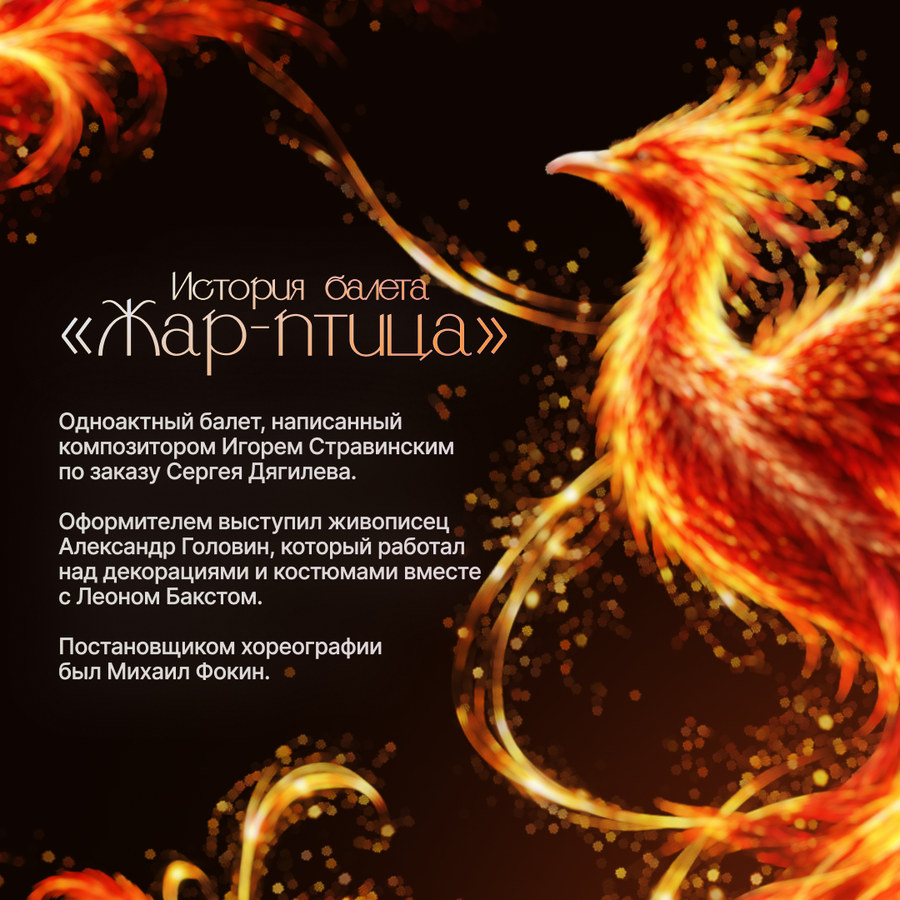
A one-act ballet composed by Igor Stravinsky at the commission of Sergei Diaghilev.
The costumes and set design was created by painter Alexander Golovin, who worked on the sets and costumes alongside Léon Bakst.
The choreography was created by Michel Fokine.

The Firebird — is a fairy tale about the clash of two worlds, in which light and the living natural world triumph over the forces of lifelessness.
Prince Ivan catches the magical Firebird in the enchanted garden, and in return for her freedom, she gives him a life‑saving feather. With its help, the Prince defeats the evil Koschei the Immortal, destroys his dark realm, and frees the beautiful Princess from captivity, who becomes his beloved.
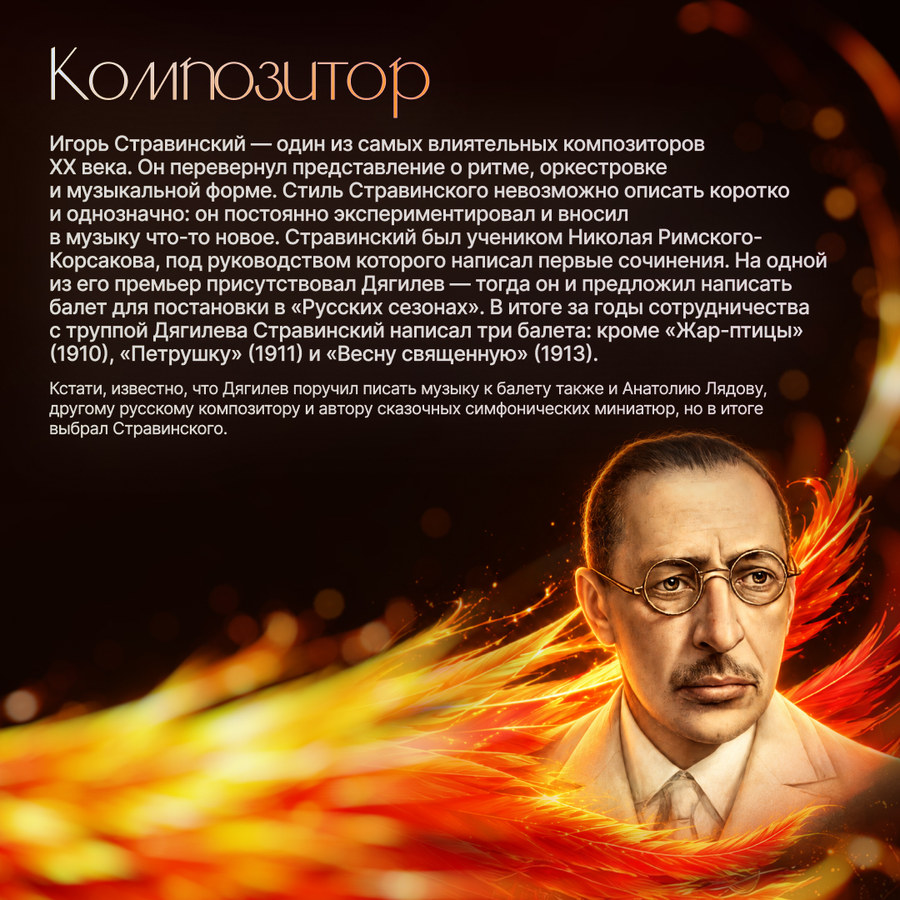
Igor Stravinsky was one of the most influential composers of the 20th century. He revolutionized concepts of rhythm, orchestration, and musical form. Stravinsky’s style defies brief or simple definition; he constantly experimented and introduced novel elements to his music. A student of Nikolai Rimsky-Korsakov, Stravinsky composed his earliest works under his mentor's guidance. Diaghilev attended one of these premieres and invited him to compose a ballet for the Ballets Russes or the Russian Seasons. Over the course of his collaboration with Diaghilev’s troupe, Stravinsky composed three ballets: The Firebird (1910), Petrushka (1911), and The Rite of Spring (1913).
Interestingly, Diaghilev had also commissioned the score from Anatoly Lyadov, another Russian composer known for his fairy-tale-inspired symphonic miniatures, but ultimately chose Stravinsky.
The principal roles in the ballet were performed by Mariinsky Theatre prima ballerina Tamara Karsavina (the Firebird) and Mikhail Fokine himself (Prince Ivan) — the ballet’s choreographer and a former principal dancer at the Mariinsky. The orchestra was conducted by Gabriel Pierné, a distinguished French composer, conductor, and organist who went down in music history as a key guardian and continuator of the traditions of French musical lyricism.
Initially, the role of the Firebird was intended for Anna Pavlova, but she declined it.
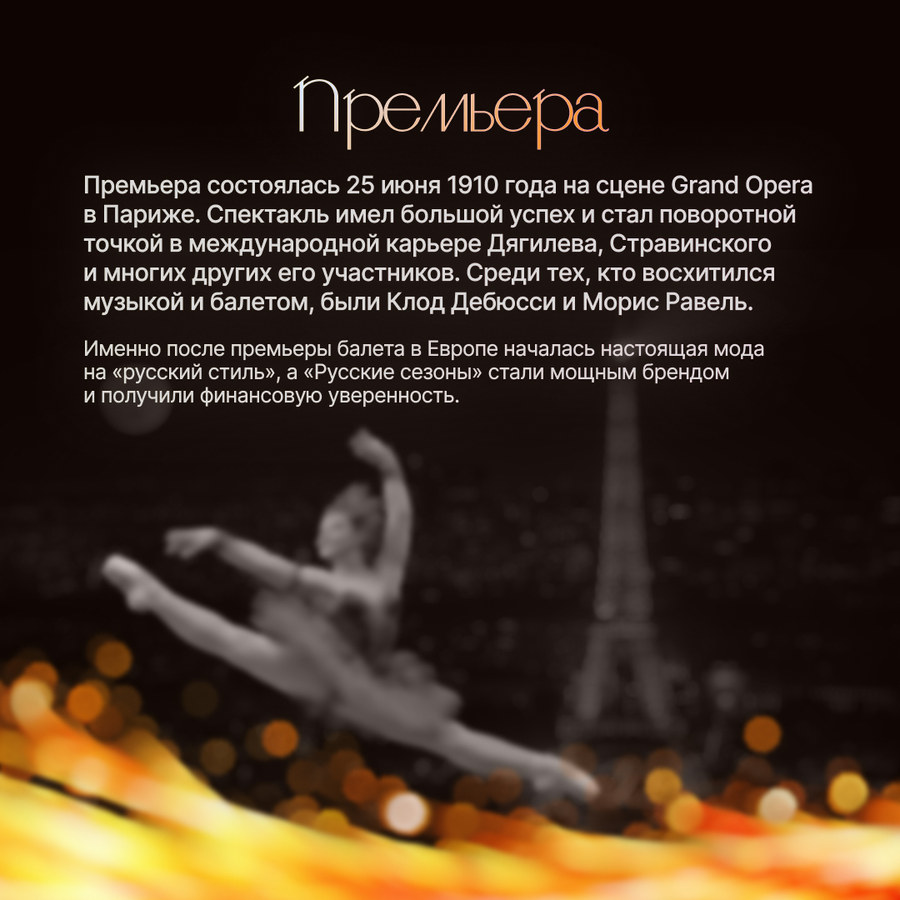
The premiere took place on June 25, 1910, at the Grand Opéra in Paris. The production was a huge success and marked a turning point in the international careers of Diaghilev, Stravinsky, and many other participants. Among those who admired the music and the ballet were Claude Debussy and Maurice Ravel.
It was following the ballet's premiere that a genuine craze for the Russian style swept across Europe, while the Ballets Russes established itself as a powerful brand and gained financial stability.
The ballet was groundbreaking in every sense, showcasing a "synthesis of the arts", a complete fusion of choreography, music, and visual arts.
A distinctive choreographic feature was the combination of classical traditions with elements of Isadora Duncan’s free dance style; for instance, Tamara Karsavina danced en pointe, while the Tsarevnas performed barefoot. The Firebird’s movement style was also unique, characterized by sharp, impulsive leaps and sudden pauses.
The music did not merely serve as a rhythmic backdrop but actively drove the narrative; specific musical leitmotifs corresponded to every step, beat of a wing, or character entrance.
Furthermore, the artist acted as a true co-creator. The costumes and set design did more than just decorate the stage, they created the mystical atmosphere of a fairy tale.
In 1921, Fyodor Lopukhov staged his Firebird in Petrograd, an avant-garde interpretation of Stravinsky’s music. New versions emerged in the 1960s: Konstantin Boyarsky staged the ballet in Leningrad, while Stanislav Vlasov and Nikolai Simachev mounted a production at the Bolshoi Theatre based on Fokine’s choreography.
In 1978, Boris Eifman created his own Firebird, featuring modern movement and acrobatic lifts. Then, in 1994, Andris Liepa reconstructed Fokine’s version for the Mariinsky Theatre, working from remaining sketches.
The Firebird was the main theme at the opening ceremony of the Sochi Olympic Games, where suites from Stravinsky’s ballet were also performed. Elements of the image were incorporated into the design of the Olympic cauldron, the Olympic torch, and the Russian team's uniforms.
At the 2020 Tokyo Olympics, Arina Averina performed her hoop routine to music from the ballet. Russian figure skater and 2022 Olympic champion Anna Shcherbakova also performed to the Firebird score.

For the first time, the Alina children's charity rhythmic gymnastics festival’s program will be based on a theatrical production. Much like Diaghilev’s legendary ballet, the show will blend various art forms such as dance, music, and visual arts. For the first time, the festival will be accompanied by a live orchestra, conducted by People's Artist of Russia Valery Gergiev. Sports will play a central role in the program: the highly complicated elements performed by the gymnasts will add expressiveness and uniqueness to the spectacle.
The 2026 Alina festival in India promises to be a spectacular event in the worlds of sport and culture, continuing the legacy established by Stravinsky’s Firebird over a century ago.